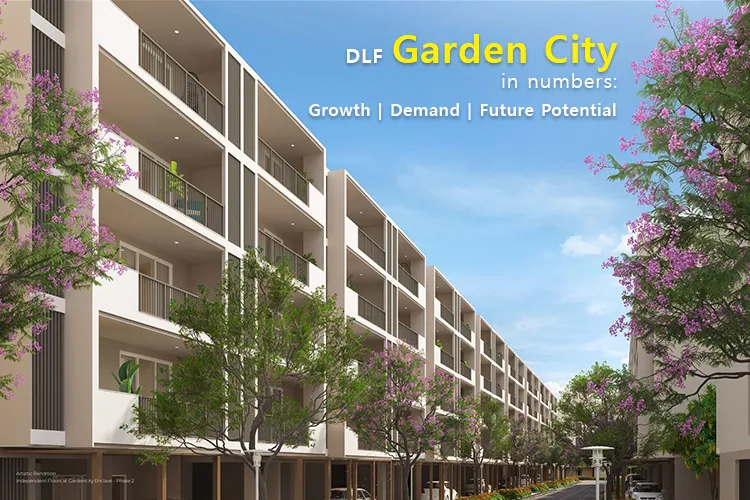
When you look at large-scale townships in Gurgaon, very few projects actually hold up when you strip away the marketing and look purely at numbers. DLF Garden City is one of those rare cases where the data tells a strong story. This is not just another residential cluster; it is a 164-acre integrated ecosystem that has been steadily building value over time.
Let’s break it down properly, no fluff, just what the numbers actually reveal about growth, demand, and where this project is headed.
Table of Contents
- Project Scale And Planning: What The Numbers Really Say
- Price Movement And Appreciation Trends
- Location Advantage And Infrastructure Growth
- Demand Drivers: Why Buyers Are Choosing This Project
- Construction Quality And Design Efficiency
- Comparing With Nearby Projects
- Future Potential: What The Next 5 to 10 Years Could Look Like
- Final Verdict
Project Scale And Planning: What The Numbers Really Say
DLF Garden City spreads across approximately 164 acres, which immediately puts it in a different league compared to typical standalone societies. Large land parcels matter because they allow better planning, wider roads, more open spaces, and long-term infrastructure flexibility. So basically, you get a lot of greener spaces with DLF Garden City right in the heart of Gurgaon.
Out of this, nearly 30% is open area. That is not a statistic that is very random. In real estate, open space directly impacts livability, density, and resale appeal. Higher open space usually translates into better long-term appreciation because overcrowded projects age poorly.
The project consists of 1,263 units, which again is a balanced number for a township of this size. It is not excessively dense, which helps maintain exclusivity, but still large enough to create a functioning community with amenities that actually get used.
The presence of low-rise independent floors with private lift access is another important data point. This is a shift in buyer preference; people are moving away from high-rise congestion and towards low-density luxury living. DLF has clearly aligned the product with that demand.
Price Movement And Appreciation Trends
Let’s get straight to what most investors actually care about—money.
DLF Garden City in Sector 91 has seen approximately 7.66% price appreciation in the last one year. Now, on the surface, that might not sound explosive. But here’s the reality—steady appreciation in a ready-to-move project is far more reliable than volatile spikes in under-construction properties.
If you look at the property prices in Gurgaon at present, the current pricing ranges between ₹4.5 crore and ₹11.25 crore, depending on plot size and configuration. That wide range is not a weakness; it actually indicates layered demand. Different buyer segments are entering the same ecosystem, which strengthens resale liquidity.
What’s more interesting is the resale activity. There are multiple listings in the ₹6–9 crore range, which shows that transactions are happening, not just listings sitting idle. A market where properties actually move is always healthier than one where prices are “theoretical.”
Rental data adds another layer to this. Monthly rents ranging from ₹35,000 to ₹48,000 indicate consistent tenant demand. This is driven largely by proximity to employment hubs like IMT Manesar and connectivity to NH-48.
Location Advantage And Infrastructure Growth
Numbers alone don’t drive real estate, location does. And Sector 91, Gurgaon, is still in its growth phase, which is exactly where smart investments usually happen.
The project sits just 5.7 km from NH-48, one of the most critical highways connecting Delhi and Gurgaon. IMT Manesar is roughly 4 km away, which is a major employment hub. This directly feeds rental demand.
The Dwarka Expressway is about 5 km away. This is crucial because infrastructure projects like this tend to drive the next wave of price appreciation. Areas that are slightly off the main corridor today often become prime zones once connectivity improves.
Social infrastructure is also within a practical radius. Schools, hospitals, and retail hubs are all within 4–5 km. That matters because end-users, not just investors, are willing to live here. And when end-users enter a market, stability improves significantly.
Demand Drivers: Why Buyers Are Choosing This Project
There are three clear demand drivers here, and ignoring them would be a mistake.
First is low-density living. Post-pandemic, buyers are actively moving away from crowded high-rises. Independent floors with private lift access directly address this shift.
Second is the ready-to-move status. The project has been ready since June 2023. That removes execution risk, which is one of the biggest concerns in Indian real estate. Buyers know exactly what they are getting.
Third is brand trust. DLF has a long-standing presence in Gurgaon. Whether people like it or not, a brand still plays a major role in high-value transactions. Buyers are more comfortable investing ₹5–10 crore for the DLF Luxury projects in Gurgaon because the developer has a proven track record.
Construction Quality And Design Efficiency
This is where most projects fail, but DLF Garden City holds up reasonably well.
The structure follows Seismic Zone IV compliance, which is critical for safety in North India. Flooring includes marble in common areas and laminated wood in bedrooms—standard for premium housing, but still important.
The presence of full air-conditioning across living areas and bedrooms is another detail that affects real-world livability. Many projects advertise luxury but cut corners here.
Power backup ranges from 6 KVA to 10 KVA depending on unit size. That’s not excessive, but it is sufficient for essential operations during outages.
Security includes CCTV surveillance in key zones, which again is expected at this price point but still necessary for buyer confidence.
Comparing With Nearby Projects
When you compare DLF Garden City with nearby developments like DLF New Town Heights, Signature Global City, or Ramprastha projects, the positioning becomes clearer.
Most competing projects either fall into the mid-segment or lack the same level of planning scale. DLF Garden City sits in a more premium bracket, but it justifies that through land size, density control, and product design.
This positioning is important because premium projects tend to hold value better during market corrections. They may not always deliver the fastest returns, but they are more resilient.
Future Potential: What The Next 5 to 10 Years Could Look Like
Now let’s talk about where this is heading, not just where it stands today.
Sector 91 is still developing. That means infrastructure is catching up, not saturated yet. Areas like this typically see gradual but sustained appreciation rather than sudden spikes.
The expansion of Dwarka Expressway and continued growth of IMT Manesar will likely push more working professionals into this belt. That directly increases both rental demand and end-user demand.
DLF also continues to launch projects in nearby sectors, which creates a cluster effect. When a strong developer builds multiple projects in a region, it usually elevates the overall micro-market.
However, here’s the reality check. This is not a “double your money in 2 years” kind of investment. If that’s what someone is expecting, they’re thinking unrealistically. This is a stability-driven, long-term play.
Final Verdict
If you strip everything down to facts, DLF Garden City stands on three solid pillars: scale, steady appreciation, and evolving location advantage.
The numbers show controlled growth, not hype-driven inflation. Demand is backed by both end-users and investors. Infrastructure is improving, but not yet fully priced in. That combination is rare.
But it is not perfect. Entry prices are already high, so upside will be gradual, not explosive. Also, Sector 91 still needs time to mature fully compared to core Gurgaon sectors.
If someone is looking for quick speculative gains, this is not the right fit. But if the goal is long-term value, stable rental income, and relatively lower risk within the luxury segment, the numbers make a strong case. And in real estate, numbers rarely lie.
Our Latest Blogs


Related Blogs
Puri The Aravallis Review: ROI, Growth Potential, and Future Value
You don’t land on Puri, the Aravallis, by accident. You land here after filtering out...
Read more
Future Growth Potential of Godrej Astra, Sector 54, Gurgaon
Gurgaon’s luxury housing demand has been accelerating fast. The growth has been driven by expanding...
Read more
BPTP Gaia Residences: High Growth Potential Explained
The Gurgaon real estate market has evolved rapidly over the last few years, but very...
Read more
M3M Antalya Hills: High Growth Potential in Sector 79
Let’s look at things from a realistic point of view. Gurgaon is flooded with projects...
Read more
Step Into a Greener Chapter at DLF Garden City
Imagine this. You wake up, and the first thing you notice is not the noise...
Read more
ROI Potential of DLF Regal Gardens
When people search for something like ROI in DLF Regal Gardens, they’re not looking for...
Read more
Unlock High Growth Potential with M3M Soulitude
For years, high-rise towers defined luxury in the urban landscapes. Today, the narrative is changing....
Read more
Invest in AIPL Lake City for a Secure Future Address
There are people who have been scanning Gurgaon’s skyline for that one perfect property. The...
Read more