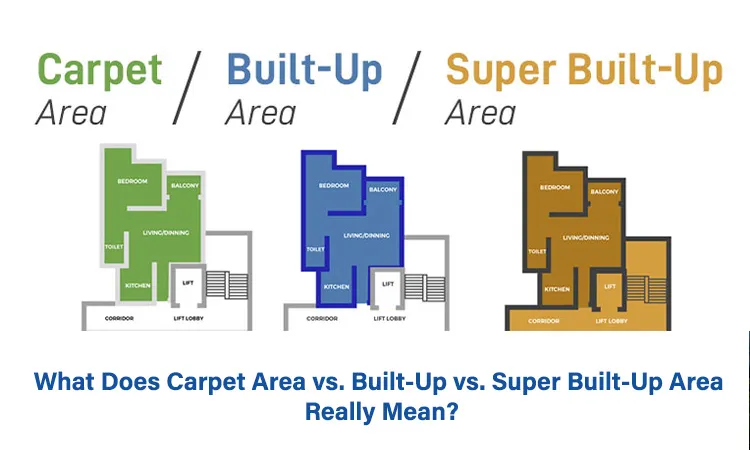
One of the most common sources of confusion for homebuyers in India is understanding how property area is measured. Terms like carpet area, built up area, and super built up area are frequently used in brochures and pricing sheets, but they do not mean the same thing. In fact, the difference between these three terms can significantly change how much usable space you actually get compared to what you pay for.
Since property prices are calculated per square foot, misunderstanding these terms can lead to incorrect comparisons and poor investment decisions. This is why every buyer should clearly understand what each term represents before evaluating any property.
Table of Contents
- What is Carpet Area?
- What is Built Up Area?
- What is Super Built Up Area?
- Key Differences Between Carpet, Built Up, and Super Built Up Area
- Understanding Loading Factor in Real Estate
- Impact of RERA on Area Measurement
- Common Mistakes Homebuyers Make
- How to Evaluate Property Area Correctly
- Why Carpet Area is the Most Important Metric
- Conclusion
What is Carpet Area?
Carpet area refers to the actual usable area inside the walls of a residential unit. It is called carpet area because it represents the space where a carpet can be laid without obstruction.
Carpet area includes all internal usable spaces such as bedrooms, living rooms, kitchen, bathrooms, and internal partitions. It does not include external walls, balconies, terraces, or any shared areas of the building.
Under RERA regulations in India, carpet area is the mandatory standard for property disclosure. Developers are required to clearly mention carpet area in all agreements and advertisements so that buyers know the actual usable space they are paying for.
Carpet area is the most important metric for buyers because it reflects real livable space. It directly affects comfort, furniture planning, and overall usability of the home. This is also why it plays a key role when analyzing evaluating new construction versus resale properties for better investment outcomes, where efficiency of space usage becomes critical.
What is Built Up Area?
Built up area is the total area of the apartment that includes carpet area along with the thickness of walls and certain additional spaces such as balconies.
It consists of the carpet area along with internal and external walls, balcony space, and, in some cases, utility ducts.
Built up area is always higher than carpet area because it includes non usable structural components. On average, built up area is about 10 to 20 percent more than carpet area, depending on the design and layout of the apartment.
However, built up area does not include shared amenities such as lifts or clubhouses. It only includes the private structural footprint of the unit.
While built up area provides a broader idea of the size of the apartment, it does not represent actual usable living space. This is why it should not be used alone for comparing properties.
What is Super Built Up Area?
Super built up area is the most widely used measurement in property pricing and marketing. It includes built up area along with a proportionate share of common areas in the building or housing society.
Common areas include lobbies and corridors, staircases, elevators, clubhouse, gymnasium, swimming pool, and gardens along with other shared facilities.
Since these areas are shared among all residents, developers distribute their cost among all units using a concept called loading factor. The loading factor is usually between 20 percent and 30 percent depending on the amenities provided in the project. Luxury projects with more facilities generally have higher loading factors.
Super built up area is calculated as:
Carpet area plus loading factor share of common areas
This measurement is often used for pricing purposes but does not represent actual usable space inside the apartment. It is mainly used by developers to present the total chargeable area of a unit to buyers. However, buyers should always compare it with carpet area to understand the actual usable space they are paying for.
Key Differences Between Carpet, Built Up, and Super Built Up Area
The difference between these three measurements can be understood in simple terms.
Carpet area is the actual usable space inside the apartment.
Built up area includes carpet area plus walls and balconies.
Super built up area includes built up area plus shared common spaces.
Among these, carpet area is the only true representation of livable space. The other two are used mainly for construction planning and pricing calculations. Understanding this difference is essential when evaluating rental returns, especially while studying whether rental income remains a stable passive income stream, since rent should ideally be evaluated based on usable space rather than inflated area.
Understanding Loading Factor in Real Estate
The loading factor is the percentage difference between carpet area and super built up area. It represents the share of common spaces allocated to each unit.
For example, if the carpet area of an apartment is 1000 square feet and the loading factor is 25 percent, then the super built up area becomes 1250 square feet.
This means that 250 square feet is not part of your actual usable space but is included in pricing as your share of common areas. Higher loading factors increase the apparent size of the property but also increase the total cost. This is why understanding loading factor is important before making any purchase decision.
Impact of RERA on Area Measurement
Before the introduction of RERA, developers often used super built up area as the primary pricing metric, which led to confusion among buyers. There was no standard definition of usable space, and buyers often ended up paying for more than what they received.
With RERA regulations, carpet area has become the mandatory standard for disclosure. Builders must clearly mention carpet area in agreements and cannot mislead buyers using only super built up figures.
RERA also ensures that deviations between promised and actual carpet area remain within regulated limits. This has improved transparency and reduced buyer risk significantly.
This regulatory clarity also helps buyers make better financial decisions when comparing cash purchase vs home loan strategies in 2026 real estate decisions, since loan calculations are more accurate when based on standardized area definitions.
Common Mistakes Homebuyers Make
One of the most common mistakes buyers make is comparing properties based only on price per square foot without checking whether the measurement refers to carpet, built up, or super built up area.
Another mistake while buying a home is assuming that super built up area represents actual usable space, which is not true. Buyers also often ignore the loading factor, which can significantly change the value of what they are actually paying for.
Many buyers also fail to verify carpet area in the sale agreement and rely only on brochure figures, which can lead to confusion later.
How to Evaluate Property Area Correctly
To evaluate any property correctly, buyers should follow a simple approach.
First, always check the carpet area to understand actual usable space.
Second, review the built up area to understand structural size.
Third, consider super built up area only for pricing comparison and not for usability.
This approach ensures that buyers are comparing properties on a fair and accurate basis.
It is especially useful when deciding between different property types while analyzing new construction versus resale properties for better investment outcomes, where space efficiency and layout differences can significantly impact livability.
Why Carpet Area is the Most Important Metric
Among all three measurements, carpet area is the most important because it directly represents usable space inside the home.
It affects how furniture is arranged, how comfortable the home feels, and how efficiently space is used. It also influences rental value and resale value more than any other measurement.
Even two apartments with the same super built up area can feel very different if their carpet area efficiency differs. For this reason, experienced buyers always prioritize carpet area when making property decisions.
Conclusion
Carpet area, built up area, and super built up area are three different ways of measuring property size, but they do not represent the same thing.
Carpet area represents actual usable space inside the home. Built up area includes structural elements such as walls and balconies. Super built up area includes shared amenities and applies a loading factor for common spaces.
Understanding these differences is essential for every homebuyer in India. It helps avoid confusion, ensures fair comparison between properties, and leads to better financial and investment decisions.
A clear understanding of these terms is not just technical knowledge. It is a practical tool that helps buyers make smarter real estate choices and avoid overpaying for non-usable space.
Our Latest Blogs


Related Blogs

Rental Market in Gurgaon: Best Areas for High Returns
If you’re looking at Gurgaon purely from an investment angle, rental income is where things...
Read more
Fastest Growing Residential Areas in Gurgaon in 2026
2026 has come to an end, and we look ahead to 2026. The residential real...
Read more
What Makes Elan Empire a Smart Commercial Investment
Commercial real estate in Gurgaon has changed a lot over the last few years. Instead...
Read more
What Daily Life Looks Like at DLF New Town Heights
Choosing a home is rarely just about square footage, amenities, or property prices. What truly...
Read more
What Retail Brands Can Expect from M3M Route 65
The retail landscape in Gurgaon continues to evolve as consumer preferences shift toward experiential shopping...
Read more
What Makes DLF Park Place a Preferred Choice for Families
When it comes to premium residential addresses in Gurgaon, few names carry the same reputation...
Read more
What Buyers and Investors Should Know About Elan Imperial
Gurgaon continues to attract businesses, investors, and brands looking for commercial spaces that are very...
Read more
What Makes Elan Miracle Attractive for Modern Businesses?
Commercial real estate in Gurgaon has changed dramatically over the last few years. Businesses are...
Read more