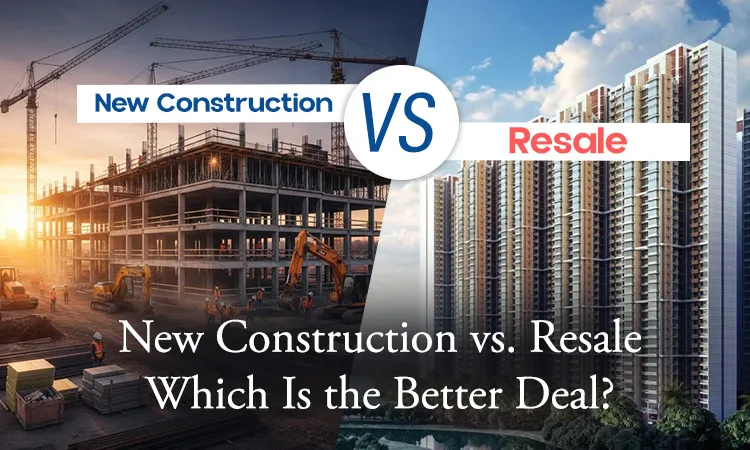
Buying a property is no longer just about owning a home. It is a financial decision that directly affects your long-term wealth, lifestyle, and future flexibility. And one question almost every buyer faces today is simple: Should you buy a brand-new property or go for a resale one?
There is no universal answer because both options come with clear advantages and obvious trade-offs. A newly launched project may offer modern amenities and better infrastructure planning, while a resale property may provide better location advantages and lower upfront costs.
The smarter choice depends on what matters more to you: appreciation potential, immediate usability, rental income, budget flexibility, or long-term convenience.
Table of Contents
- Understanding The Real Difference Between New And Resale Properties
- New Projects Usually Cost More Upfront
- Resale Properties Offer Better Negotiation Opportunities
- Modern Amenities Are Clearly Better In New Projects
- Location Still Favors Resale Properties In Many Cases
- Maintenance Costs Can Change The Entire Equation
- Rental Income Potential Depends More On Location Than Age
- Legal Verification Is Critical In Both Cases
- So, Which Option Is Actually Better?
- Final Thoughts
Understanding The Real Difference Between New And Resale Properties
A new construction property is either under construction or has been recently completed by a developer. Buyers usually enter during the pre-launch, launch, or construction phases.
A resale property, on the other hand, already has an owner and is being sold again in the secondary market.
At first glance, especially for a person who is buying a house for the first time, the decision may seem simple. New properties look modern and attractive, while resale homes often appear older. But the real comparison goes much deeper than appearance.
Factors like pricing, taxes, usable space, legal clarity, maintenance costs, and future appreciation all matter.
New Projects Usually Cost More Upfront
One of the biggest differences buyers notice immediately is pricing.
New construction projects typically cost more than comparable resale properties in the same region. Industry data shows that new homes are often priced around 9 to 10% higher than resale units because developers include modern amenities, landscaping, clubhouses, smart features, and branding premiums.
However, buyers still prefer new projects because they believe future appreciation will compensate for the higher entry price. This thinking is not completely wrong.
In rapidly growing markets like Gurugram, several newly launched luxury projects have witnessed strong appreciation during the construction phase itself, especially near developing infrastructure corridors. That is why it is always important to make up your mind if you want to go for an under-construction or ready to move in project while buying a property.
But buyers also need to remember that under-construction properties attract GST, while resale properties do not. This directly impacts the final acquisition cost.
Hence, the actual price difference can become much larger than what is visible initially.
Resale Properties Offer Better Negotiation Opportunities
One advantage resale properties still hold strongly is price negotiation.
Developers usually maintain fixed pricing structures with limited flexibility, especially in premium projects. But resale sellers are often more open to negotiation depending on urgency, financial conditions, or market sentiment.
This creates opportunities for buyers to secure better deals.
In many cases, buyers also get larger usable spaces in resale apartments because older developments generally had lower loading factors. Modern projects sometimes allocate a higher percentage of space toward clubhouses, corridors, and shared amenities. But yes, you should always verify certain things before buying a resale property in the market.
So while a new project may look larger on paper, the actual carpet area difference can surprise buyers.
Modern Amenities Are Clearly Better In New Projects
This is where new construction projects dominate.
Most modern developments now focus heavily on lifestyle infrastructure. Smart home automation, co-working lounges, wellness zones, sports facilities, air purification systems, EV charging stations, and resort-style clubhouses are becoming standard features in premium housing.
Older resale properties often struggle to match this ecosystem.
And honestly, this matters more today than it did earlier.
Post-pandemic buyers are no longer looking at homes only as living spaces. They want integrated lifestyle environments. Developers understand this shift very well, which is why amenity-driven projects are witnessing stronger demand.
For families, younger professionals, and high-income buyers, these modern conveniences often justify the premium pricing.
Location Still Favors Resale Properties In Many Cases
While new projects win on amenities, resale properties often win on location maturity.
Most resale apartments are situated in well-established sectors with developed roads, operational schools, nearby hospitals, public transport, and active retail markets.
New projects are frequently located in developing corridors where infrastructure is still evolving.
This creates a very important trade-off.
A new property may have stronger future appreciation potential, but a resale property often offers better immediate convenience.
For example, sectors near DLF Cyber City or older parts of Golf Course Road provide strong social infrastructure today. Meanwhile, emerging areas near the expressway may offer future upside but still require patience from buyers.
So the decision depends heavily on your timeline and lifestyle priorities.
Maintenance Costs Can Change The Entire Equation
Many buyers underestimate maintenance costs while comparing properties.
A newly constructed property naturally requires fewer repairs during the initial years. Plumbing systems, electrical fittings, elevators, and structural components are brand new, reducing immediate maintenance expenses.
Resale properties can become expensive if the building is poorly maintained or aging badly.
Water leakage, old wiring, outdated lifts, repainting requirements, and structural repairs can increase ownership costs significantly over time.
At the same time, not every older property is problematic.
Several well-maintained societies continue offering excellent value because the construction quality during earlier periods was sometimes stronger than today’s high-density developments.
Hence, buyers should evaluate maintenance history instead of blindly judging based on age alone.
Rental Income Potential Depends More On Location Than Age
A common myth in real estate is that new properties always generate better rental returns.
That is not necessarily true.
Rental demand usually depends more on connectivity, office proximity, and surrounding infrastructure than the age of the building itself.
A well-located resale apartment near business hubs may outperform a newly launched project located farther away from commercial zones.
In Gurugram, rental demand remains strongest near corporate belts, metro corridors, and established residential clusters.
So investors focused primarily on rental income should prioritize location fundamentals over project novelty.
Legal Verification Is Critical In Both Cases
A lot of buyers assume new projects are automatically safer. That assumption can become dangerous.
Even in new construction projects, buyers must carefully verify:
- RERA registration
- Land ownership
- Developer credibility
- Construction approvals
- Delivery timelines
Similarly, resale properties require title verification, mutation checks, and encumbrance validation to ensure there are no ownership disputes or pending liabilities.
Legal due diligence is not optional in either case.
Skipping verification simply because a project looks premium is careless investing.
So, Which Option Is Actually Better?
The reality is that both categories serve different types of buyers.
If you want modern amenities, future appreciation potential, flexible payment structures, and a newer lifestyle ecosystem, new construction projects make more sense.
But if your priority is immediate possession, developed surroundings, better location maturity, lower upfront taxation, and stronger negotiation opportunities, resale properties can deliver better practical value.
There is no perfect answer.
The smarter decision comes from understanding your financial goals instead of blindly following market trends.
A buyer focused on long-term appreciation may prefer a strategically located new launch. A family prioritizing convenience and established infrastructure may find resale properties more practical.
Final Thoughts
The debate between new construction and resale properties is not about which category is universally superior. It is about which one aligns better with your priorities.
Modern buyers often get distracted by marketing, luxury clubhouses, or short-term hype. But real estate remains a long-term asset class where fundamentals matter far more than appearances.
Location quality, developer credibility, maintenance standards, infrastructure growth, and financial planning will always matter more than whether a property is brand new or previously owned.
And in all probability, buyers who evaluate these fundamentals carefully will make better investment decisions regardless of which category they choose.
Our Latest Blogs


Related Blogs

Ready-to-Move vs Under-Construction in Gurgaon: What to Choose?
There are broadly two types of property buyers in Gurgaon. There are those who value...
Read more
Things to Verify Before Purchasing a Resale Property in Gurgaon
Gurgaon has evolved into one of India’s most dynamic real estate markets. The growth in...
Read more
Resale Value and Trends for DLF The Belaire Apartments
DLF The Belaire is in Sector 54, Gurgaon. The property isn’t just another luxury project....
Read more
Leasehold vs Freehold Property: Which One Should You Choose?
Buying a house is often considered one of the biggest financial decisions a person makes....
Read more
Commercial Property vs Residential Property Loan
A property is often considered one of the most valuable assets a person owns. Beyond...
Read more
Retail Shops vs SCO Plots: Which Is a Better Investment?
Investing in commercial real estate is one of the most effective ways to build long-term...
Read more
Best Commercial Projects in Gurgaon for Long-Term Investment
Gurgaon continues to remain one of the most attractive real estate markets in India, driven...
Read more
REITs vs Direct Property Investment: Which Offers Better Returns
There is a moment every investor reaches where the spreadsheets stop helping.One option promises flexibility,...
Read more