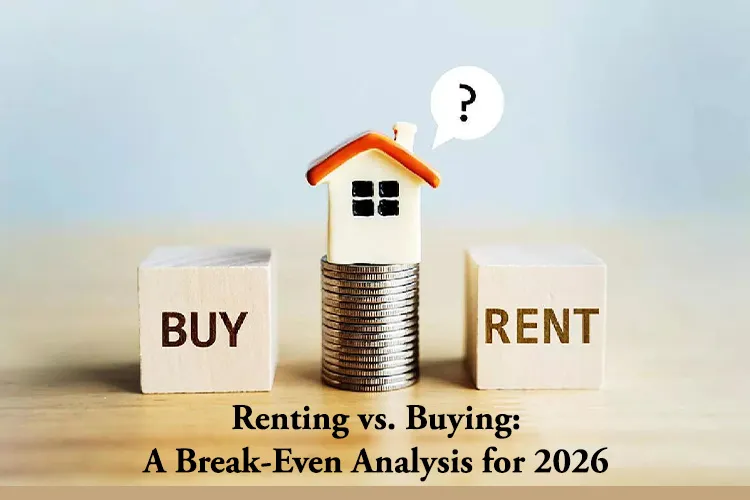
Choosing between renting and buying a home in 2026 is no longer just a decision that is based on emotions alone. It’s a game of numbers. The real question isn’t “Which is better?” but “At what point does buying become financially smarter than renting?” That point is called the break-even horizon, and understanding it can save (or make) you lakhs over time.
With the rates of interest changing constantly, prices of property constantly rising, inflation, and evolving career mobility, the rent vs. buy debate in 2026 has become more strategic than ever.
Table of Contents
- What Is the Break-Even Point in Real Estate?
- The 5% Rule: A Quick Financial Reality Check
- Renting in 2026: Where It Wins
- Buying in 2026: Where It Wins
- The Hidden Costs Most Buyers Ignore
- The Hidden Cost of Renting: Inflation
- Real Estate Trends That Influence the 2026 Decision
- Renting vs Buying Based on Life Stage
- A Practical Break-Even Example (India – 2026)
- The Smart Strategy in 2026
- Conclusion: The Winner Is Your Timeline
What Is the Break-Even Point in Real Estate?
The break-even point is the time you must stay in a home that’s been purchased for the total cost of buying to become lower than the cost of renting a similar property.
In simple terms, you should always take a note of the seemingly small factors that drive demand in real estate today. The points you should note are:
- If you sell before this period, renting was cheaper
- If you stay beyond this period, buying becomes profitable
In 2026, the average break-even horizon is around 5-6 years, though it varies based on:
- Property price
- Loan interest rate
- Rent in your city
- Maintenance and taxes
- Appreciation potential
This timeline is the single most important factor in your decision.
The 5% Rule: A Quick Financial Reality Check
A widely used method to compare renting and buying is the 5% rule, which estimates the annual cost of owning a house.
How it works:
Take the property value and calculate 5% of it.
This 5% typically covers the following things:
- Loan interest
- Taxes related to property
- Maintenance
- Insurance
- Opportunity cost of your down payment
Example:
If a home costs ₹1 crore:
- 5% of ₹1 crore = ₹5 lakh per year
- Monthly cost = ₹41,666
Now compare:
- If similar rent is less than ₹41,666 - Renting is cheaper
- If rent is more - Buying makes more sense
This simple formula instantly tells you which side the math favours.
Renting in 2026: Where It Wins
Renting is not “wasted money”. That’s a myth when it comes to finances. It’s actually a choice that is strategic in many situations.
Short-Term Living Plans
If your stay is less than 5 years, buying a home for the first time is usually a loss because:
- You pay stamp duty & registration
- You pay brokerage
- You pay loan interest (which is highest in early years)
- You pay resale costs later
You won’t build enough equity to recover these expenses.
Lower Upfront Financial Burden
Buying requires:
- 15–25% down payment
- Stamp duty & registration
- Interior & setup cost
Renting requires:
- 1–2 months’ security deposit
That’s a massive liquidity difference.
Flexibility for Career Growth
In 2026, job mobility is high. Renting allows you to:
- Move for better opportunities
- Upgrade or downgrade your lifestyle
- Live closer to work
Without being stuck with an unsellable asset.
Zero Maintenance Stress
When you rent:
- Repairs are the landlord’s problem
- No society charges for major upgrades
- No property tax burden
That predictability has real financial value.
Buying in 2026: Where It Wins
Buying becomes powerful when time is on your side.
Forced Wealth Creation
Your EMI does two things:
- Pays interest
- Builds ownership (equity)
Rent does only one:
- Pays your landlord
Over 10–15 years, this difference becomes enormous.
Inflation Protection
Your EMI stays mostly stable, but rents:
- Increase 5–8% annually in Indian cities
So a house that feels expensive today becomes affordable later as your income grows.
Tax Benefits
In India, homeowners get:
- Up to ₹1.5 lakh deduction on principal (Section 80C)
- Up to ₹2 lakh deduction on interest (Section 24)
For joint owners, these benefits multiply.
Asset Appreciation
Real estate in strong micro-markets continues to appreciate, especially in:
- Infrastructure-driven corridors
- Emerging business hubs
- Premium gated communities
This creates long-term net worth.
Real Estate Trends That Influence the 2026 Decision
Your decision must also reflect market reality.
Stabilising Interest Rates
Home loan rates are expected to remain in the 8-9% range in India, making planning easier.
End-User Driven Market
2026 is not a speculative market; it’s dominated by actual homebuyers, which supports long-term price stability.
Rise of Suburban Growth
Peripheral areas with infrastructure development are seeing:
- Better affordability
- Higher appreciation potential
This improves the buying case for long-term users.
Renting vs Buying Based on Life Stage
Renting makes more sense if:
- You are early in your career
- Your job location may change
- You don’t have emergency savings
- You want investment flexibility
Buying makes more sense if:
- You plan to stay 6+ years
- You have stable income
- You have a long-term family plan
- You are buying in a growth corridor
A Practical Break-Even Example (India – 2026)
Let’s assume:
Property price: ₹80 lakh
EMI: ₹64,000
Rent for similar home: ₹30,000
At first glance - renting wins.
But after:
- Rent increases every year
- EMI stays extremely stable
- Benefits of tax reduce the effective EMI
- Property appreciates
The break-even point typically occurs between years 5 and 7.
After that, buying becomes more profitable very significantly.
The Smart Strategy in 2026
Buyers who are financially aware are not asking “Should I buy?”
They are asking:
“How long will I stay?”
That single answer decides every other thing.
Some modern hybrid strategies include:
- Renting where you live, buying where you invest
- House hacking (renting out a room)
- Buying in high-growth suburbs instead of prime, overpriced areas
But in every situation, you need to analyse the home-inspection reports thoroughly.
Conclusion: The Winner Is Your Timeline
In 2026, renting and buying are both smart when used at the right time.
You should always opt for renting if the following conditions are met:
- Your future is not very certain
- You need flexibility
- You want to invest your surplus elsewhere
Choose buying if:
- You can stay for 6+ years
- You have stability when it comes to your experiences
- You are purchasing in a micro-market that is strong
Because the truth is simple:
-Renting saves you money in the short term
-Buying builds wealth in the long term
The break-even point is where the shift happens.
So before making the decision, don’t just compare rent and EMI, calculate your horizon of time, total cost, and goals for the long term.
That’s the real formula for making the right move in 2026.
Our Latest Blogs


Related Blogs

NRI's Guide to Buying Property in Gurgaon
Gurgaon has quietly moved from being just another NCR extension to becoming one of the...
Read more
A Beginner's Guide to Buying a First Home
Is there anything more exciting than buying your own house? But there is one thing...
Read more
Top Reasons to Consider Buying a Home at Godrej Miraya
Buying a home is rarely just about square footage or where it is located. It...
Read more
A Complete Investor's Guide to Elan Town Centre Gurgaon
Commercial real estate in Gurgaon has evolved in a very significant way over the last...
Read more
A Detailed Guide to Investing in M3M Urbana
Commercial real estate investment has evolved to a good extent over the last decade. Investors...
Read more
Top 5 Cities with the Highest Real Estate ROI in 2026
The Indian real estate market is changing rapidly in 2026. Earlier, investors mainly focused on...
Read more
Real Estate Market Predictions for the Second Half of 2026
The real estate market is entering a very different phase in 2026. After facing slow...
Read more
What Defines Luxury Living in Gurgaon in 2026?
For years, luxury real estate was easy to define: bigger homes, locations that are better,...
Read more