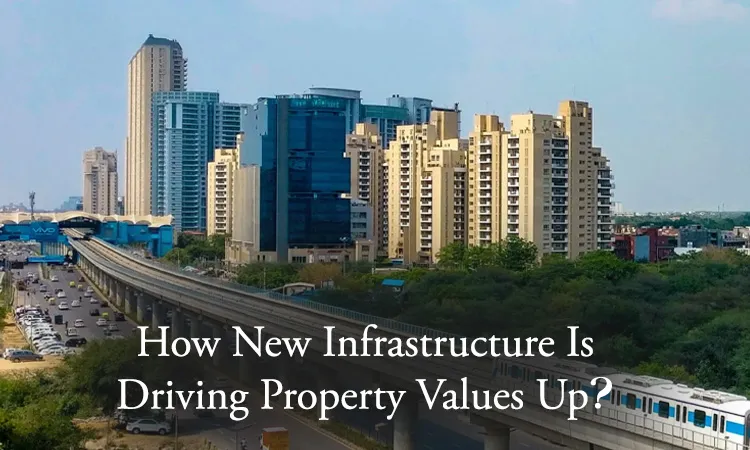
There was a time when buyers mainly looked at the size of the property, the name of the builder, and the launch price before making a decision. That approach has changed rapidly over the last few years. Today, infrastructure has become one of the biggest factors influencing real estate prices across Indian cities, especially in markets that are growing very fast, like Gurgaon, Noida, Hyderabad, Pune, and Bangalore.
Roads, metro lines, expressways, business districts, airports, and social infrastructure are no longer just supporting developments around a project. In many cases, they are the actual reason the prices of the property go up in that place.
This is exactly why investors who understand infrastructure cycles often enter markets earlier and generate returns that are stronger compared to buyers who only focus on the apartment itself.
Table of Contents
- Why Connectivity Changes Everything
- Infrastructure Creates Demand Before Buildings Do
- The Rise Of The “Future-Ready” Buyer
- Social Infrastructure Matters More Than People Think
- Commercial Growth Pushes Residential Appreciation
- Infrastructure Reduces Psychological Distance
- New Infrastructure Is Also Reshaping Buyer Strategy
- Final Thoughts
Why Connectivity Changes Everything
The biggest impact of infrastructure is usually seen through how connected the property is. The moment a new expressway, metro corridor, or elevated road comes up, an area that once felt isolated suddenly becomes something that can be accessed by the public.
That accessibility directly changes the psychology of the buyer. A location that earlier felt “too far” from offices or city centers starts becoming practical for life on a daily basis. The time taken to travel reduces. Businesses begin entering places that are nearby. The demand for residential real estate increases. Retail follows. Eventually, pricing starts moving upward.
The Dwarka Expressway is one of those examples that are very clear about this transformation. A few years ago, many buyers were hesitant about investing there because the ecosystem surrounding the property was still developing. Today, sectors along the expressway are witnessing aggressive residential and commercial growth because connectivity to Delhi and IGI Airport has improved dramatically.
This is also why conversations around how to spot a high-growth real estate project before everyone else are becoming more relevant today. Smart investors are not only studying builders anymore. They are studying infrastructure maps.
Infrastructure Creates Demand Before Buildings Do
One major mistake many first-time investors make is assuming that property appreciation happens only because of construction quality or luxury amenities.
In reality, demand usually follows infrastructure first.
The moment governments announce major transit corridors, metro expansions, industrial hubs, or commercial districts, developers begin acquiring land aggressively in nearby sectors. That early movement itself signals future growth potential.
This pattern has repeated across Gurgaon multiple times.
Golf Course Road became premium because connectivity and corporate activity improved simultaneously. Southern Peripheral Road started attracting attention once infrastructure upgrades accelerated. New Gurgaon gained momentum after road networks and residential ecosystems started stabilizing.
The important thing buyers often miss is this:
infrastructure doesn’t just improve convenience. It changes economic activity.
And wherever economic activity expands, property values usually follow.
The Rise Of The “Future-Ready” Buyer
Modern buyers are asking sharper questions than they did a decade ago.
They want to know:
Will this area become easier to access five years from now?
Will schools, hospitals, and offices come nearby?
Will rental demand remain strong?
Will resale buyers exist later?
That shift in thinking is one reason why infrastructure-led investing has become far more mainstream.
People now understand that buying in an already saturated location often limits upside potential. On the other hand, entering a developing corridor before complete infrastructure delivery can create stronger long-term appreciation.
This thinking also overlaps with topics like why pre-launch bookings are the smartest real estate move right now. Many investors choose pre-launch opportunities specifically because they want to enter before infrastructure fully transforms the surrounding market.
Once metro lines, highways, and commercial hubs become fully operational, pricing usually moves far beyond early-stage entry points.
Commercial Growth Pushes Residential Appreciation
Another important relationship buyers often underestimate is the connection between commercial infrastructure and residential demand.
Whenever office hubs expand in a region, nearby housing markets usually experience strong appreciation. Employees prefer living closer to workplaces, which increases residential absorption in surrounding sectors.
This pattern can be clearly seen around Cyber City, Golf Course Extension Road, and emerging business corridors across Gurgaon.
As office leasing activity increases, supporting ecosystems automatically follow:
cafes, retail spaces, gyms, healthcare centers, and entertainment zones all begin expanding nearby.
Eventually, the area evolves into a self-sustaining urban ecosystem.
That is also why discussions around why rental income is still a reliable passive income source continue gaining importance. Infrastructure-led locations with strong employment activity usually maintain healthier rental demand compared to isolated residential pockets.
Infrastructure Reduces Psychological Distance
One interesting thing about infrastructure is that it changes perception even more than geography.
A sector physically located 20 kilometers away may still feel “closer” if roads are wide, traffic movement is smoother, and metro connectivity exists.
On the other hand, a poorly connected location can feel exhausting despite being geographically nearby.
This psychological effect strongly influences property demand.
Buyers today are valuing time almost as much as square footage. A smoother commute often matters more than getting a slightly bigger apartment farther away.
That shift in behavior is reshaping demand in real estate patterns across India.
New Infrastructure Is Also Reshaping Buyer Strategy
Infrastructure growth is not only increasing property prices. It is also changing how buyers approach financing decisions.
In corridors that are developing very rapidly, many investors prefer leveraging home loans rather than deploying complete liquidity upfront. They would rather preserve capital while participating early in a market that they see is growing.
This is why it is important to understand whether you should go for cash or a loan in 2026. They are becoming increasingly relevant in modern real estate discussions.
As infrastructure-led appreciation accelerates, strategic financing can sometimes create better long-term capital efficiency than locking large amounts of cash into a single asset.
The smarter buyers today are studying timing, infrastructure pipelines, and future urban expansion instead of simply chasing launch hype.
Final Thoughts
Infrastructure has become one of the strongest forces shaping real estate appreciation across India. Roads, metro corridors, airports, commercial districts, and social ecosystems are no longer secondary factors in property decisions. In many cases, they are the primary reason a market grows.
The buyers generating the strongest returns today are usually the ones who identify future infrastructure growth before the wider market fully reacts to it.
Because by the time an area already feels “premium,” much of the appreciation has often already happened.
In real estate, infrastructure does more than improve mobility. It quietly rewrites the future value of an entire location.
Our Latest Blogs


Related Blogs
Impact of Metro Expansion and Infrastructure on Gurgaon Property Prices
If you’ve lived in Gurgaon long enough, you already know one thing. This city moves...
Read more
Infrastructure Development and Property Price Growth
Real estate has always followed one simple thing. And that one thing is infrastructure. And...
Read more
Leasehold vs Freehold Property: Which One Should You Choose?
Buying a house is often considered one of the biggest financial decisions a person makes....
Read more
Commercial Property vs Residential Property Loan
A property is often considered one of the most valuable assets a person owns. Beyond...
Read more
REITs vs Direct Property Investment: Which Offers Better Returns
There is a moment every investor reaches where the spreadsheets stop helping.One option promises flexibility,...
Read more
How to Identify High-Return Property Investments
If you have ever wondered why some people make serious money in real estate while...
Read more
NRI's Guide to Buying Property in Gurgaon
Gurgaon has quietly moved from being just another NCR extension to becoming one of the...
Read more
Top Emerging Sectors in Gurgaon for Property Investment
The real estate market in Gurgaon is no longer just about luxury addresses that are...
Read more
Social Infrastructure Matters More Than People Think
When people hear the word "infrastructure," they usually imagine highways and flyovers. But social infrastructure plays an equally important role in driving property values upward.
Schools, hospitals, malls, restaurants, office spaces, and entertainment zones together create what buyers now call a “livable ecosystem.”
This matters because people no longer want homes in disconnected pockets. They want complete lifestyles within a short radius.
A residential project located near reputed schools, healthcare centers, business parks, and retail hubs naturally becomes more attractive to families and working professionals.
Over time, that sustained demand strengthens both rental potential and resale value.
This is one reason why mixed-use developments and integrated townships are performing strongly in major cities today. Buyers want convenience built into daily life instead of depending on long commutes for everything.