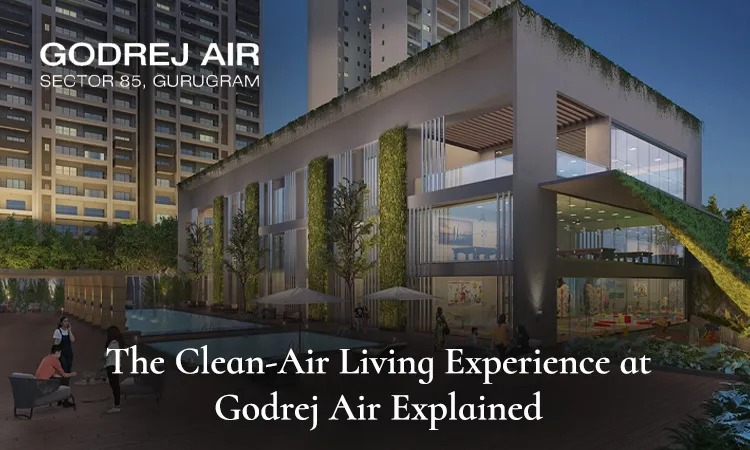
Modern urban housing in Gurgaon is increasingly defined by two competing realities. On one side is rapid infrastructure expansion, rising density, and worsening air quality. On the other is a growing demand for controlled micro-environments that attempt to restore baseline livability inside residential spaces. Godrej Air in Sector 85 positions itself within this second category. The project does not rely solely on conventional residential planning metrics such as location or carpet area. Instead, it builds its proposition around environmental control systems, spatial density management, and integrated lifestyle infrastructure.
Understanding whether this positioning is structurally meaningful requires examining each claimed feature not as a marketing element but as a functional component of residential performance.
Table of Contents
- Air Quality Engineering Through CTFA Systems
- Infrastructure Connectivity and Regional Mobility
- Home Automation as Functional Efficiency Layer
- Low Density Planning and Spatial Distribution
- Landscape Design and Environmental Mitigation
- Lifestyle Infrastructure and Cultural Programming
- Power Continuity and Utility Reliability
- Conclusion
Air Quality Engineering Through CTFA Systems
The most critical claim in Godrej Air’s positioning is the use of CTFA systems, described as delivering significantly enhanced air quality within residential units. In practical architectural terms, such systems are designed to reduce particulate matter concentration and regulate indoor air circulation independent of external atmospheric conditions.
Given Gurgaon’s average PM2.5 levels frequently exceed safe thresholds, the relevance of indoor filtration systems is not optional but functional. The effectiveness of such systems depends on filtration grade, air exchange rate, and maintenance protocols.
While the “10x improvement” claim is not independently verifiable without third-party testing data, the underlying principle aligns with global trends in sealed-building air management systems used in high-density urban developments. This is the reason why buyer are going for Godrej Air for a healthier lifestyle choice these days.
The key analytical question is not whether air is improved, but whether the system maintains consistent performance over long occupancy cycles without degradation in efficiency.
Infrastructure Connectivity and Regional Mobility
Godrej Air is located in Sector 85, a zone influenced by multiple infrastructure corridors including NH48, the Kundli Manesar Palwal Expressway, Dwarka Expressway, and the Pataudi Road network. From a real estate perspective, multi-corridor access reduces dependency on a single transport artery, which is significant in regions with fluctuating traffic loads.
However, connectivity advantage must be evaluated in terms of actual commute elasticity. While NH48 provides direct linkage between Delhi and Jaipur, peak-hour congestion often reduces theoretical travel-time advantages. The Dwarka Expressway, still developing in sections, introduces future upside rather than immediate utility.
The location therefore functions more as a forward-looking connectivity node rather than an immediately optimized transit hub.
Home Automation as Functional Efficiency Layer
The integration of home automation for controlling air conditioning, lighting, and entertainment systems reflects a shift toward energy-managed residential ecosystems. In practice, such systems contribute to marginal efficiency gains through optimized energy consumption patterns and user-defined scheduling.
However, the effectiveness of automation is dependent on interoperability, system stability, and user adoption rates. In many residential developments, automation features are underutilized due to complexity or maintenance issues. It is also a wise choice to go for smart home features and proptech adaption for complete automation of their homes.
From a functional standpoint, home automation adds value only when it reduces friction in daily energy management rather than simply adding digital control layers.
Low Density Planning and Spatial Distribution
The claim of approximately 51 homes per acre places Godrej Air in a lower-density category relative to typical Gurgaon high-rise clusters. Density is a critical determinant of livability because it directly impacts shared resource load, noise levels, and vertical congestion.
Lower density developments theoretically improve ventilation, reduce elevator load stress, and increase usable open space per resident. However, these benefits depend on actual tower placement, open area allocation, and population occupancy rates rather than declared planning ratios alone. These are some of the major reasons why buyer preferences for low-density living are increasing with each passing day.
In urban Indian contexts, the long-term challenge is not planned density but achieved density after full occupancy and resale cycles.
Landscape Design and Environmental Mitigation
The inclusion of landscaped terrace greens and purifying screens reflects an attempt to introduce bio-mitigation elements into the built environment. Vertical or terrace-level greenery can contribute to localized temperature moderation and minor particulate absorption.
However, the environmental impact of such systems is typically localized and does not substitute for broader air quality control mechanisms. Their primary value lies in psychological and visual relief rather than large-scale atmospheric correction.
The effectiveness of these interventions depends on maintenance intensity, plant selection, and irrigation sustainability.
Lifestyle Infrastructure and Cultural Programming
The presence of a dance academy managed by Delhi Dance Academy introduces a structured cultural component into the residential ecosystem. Such amenities are increasingly used in premium housing developments to enhance community engagement rather than purely recreational value.
From an analytical perspective, the actual utility depends on program consistency, access policies, and resident participation rates. Many such amenities remain underutilized when not integrated into a structured community calendar.
Power Continuity and Utility Reliability
The availability of 100 percent power backup is a standard expectation in premium housing developments in Gurgaon. Its real value lies in ensuring uninterrupted operation of HVAC systems, elevators, and water supply infrastructure.
However, power backup systems vary significantly in load capacity. The key differentiator is whether backup systems support full-load operations or only essential services. This distinction determines whether “100 percent backup” translates into full functional continuity or partial support during outages.
Conclusion
Godrej Air is structured around a specific interpretation of modern residential demand in high-pollution, high-density urban environments. Its value proposition is not centered on conventional luxury markers alone but on controlled environmental systems, density management, and integrated automation.
However, each of these features must be evaluated in terms of execution quality rather than conceptual design. Air purification systems, automation layers, and low-density claims only translate into tangible residential value when sustained consistently over time under real occupancy conditions.
In this sense, the project represents a systems-driven approach to housing rather than a purely location-driven investment product.
Our Latest Blogs


Related Blogs

Understanding the Living Experience Offered by SOBHA Strada
In a city like Gurugram, it is nowadays difficult to satisfy homebuyers and investors with...
Read more
Is Godrej Sora in Gurugram the Right Choice for Long-Term Living?
Suppose you are buying a luxury property and you’re spending ₹11.40 Cr onwards on a...
Read more
Why Families Are Choosing Godrej Astra for Better Urban Living
People nowadays want an upgrade in lifestyle. They are looking for something secure, that has...
Read more
Why Homebuyers are Turning to Godrej Sora for Modern Living?
If you’ve been keeping an eye on Gurgaon’s luxury real estate scene, you’ve probably noticed...
Read more
Top Reasons to Consider Buying a Home at Godrej Miraya
Buying a home is rarely just about square footage or where it is located. It...
Read more
Why Godrej Air Appeals to Homebuyers Seeking a Healthier Lifestyle
For years, homebuyers in Gurgaon focused on location, how connected the property is, and how...
Read more
Exploring the Long-Term Value of Godrej Miraya
When we talk about the luxury housing market in Gurgaon, it has evolved to a...
Read more
The Quiet Luxury Philosophy Behind Godrej Habitat
Luxury is changing. The days of oversized chandeliers, excessive ornamentation, and loud displays of wealth...
Read more